
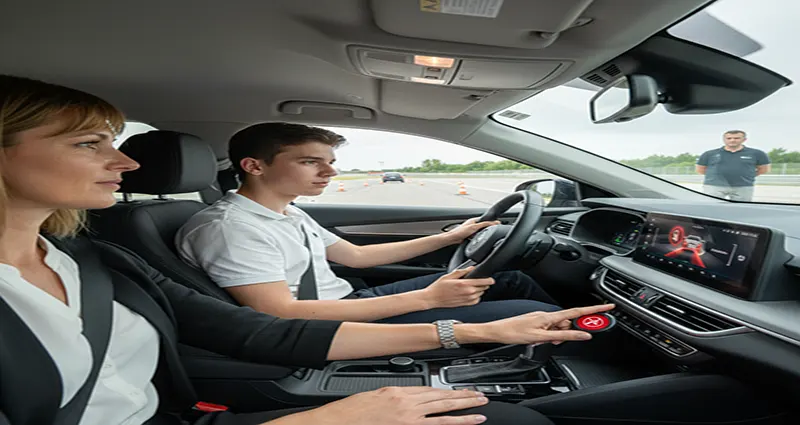
The first year of independent driving is a rite of passage, but for parents, it is often a period of high anxiety. Statistically, teen drivers are at a higher risk of accidents due to inexperience and a high susceptibility to distractions. However, as we enter 2026, a new generation of automotive technology is stepping in to act as a “digital co-pilot.”
Among the most significant advancements is Emergency Stop Assist (ESA). While related to the Automatic Emergency Braking (AEB) systems we’ve seen for years, ESA is a much more comprehensive “guardian” system designed to take over when a driver becomes completely unresponsive. For families with young drivers, understanding how this feature works could be a literal lifesaver.
What is Emergency Stop Assist (ESA)?
Emergency Stop Assist is an advanced active safety system that monitors the driver’s engagement with the vehicle. Unlike standard emergency braking—which reacts to an external obstacle like a car stopping suddenly in front of you—ESA reacts to the internal state of the driver.
If the system detects that the driver is no longer actively steering, braking, or accelerating, it initiates a multi-stage process to safely bring the vehicle to a controlled halt, prevent a high-speed collision, and alert emergency services.
The Three Stages of ESA Intervention:
- Detection & Warning: The car uses sensors on the steering wheel (capacitive touch) and interior cameras to monitor driver activity. If it detects no input for a set period (usually 10–15 seconds), it issues escalating visual and audible alerts.
- Physical Prompts: If the teen driver doesn’t respond to the beeps and lights, the car will “jerk” the brakes—a short, sharp tap intended to wake a drowsy driver or snap a distracted one back to attention.
- The Controlled Stop: If there is still no response, the car takes over. It maintains its lane using Lane Keep Assist, activates the hazard lights, and gradually slows the vehicle to a complete standstill. In some 2026 models, the car will even steer itself to the hard shoulder or the slow lane to avoid stopping in live traffic.
Why It’s a Game-Changer for Teenagers
Teenage drivers face unique risks that ESA is specifically tuned to mitigate.
1. Combating the “Distraction Trap”
Whether it’s a ringing phone or a lively conversation with friends in the backseat, teens are prone to “cognitive tunneling,” where they lose track of the road entirely. If a teen looks away for too long and the car begins to drift, ESA provides the ultimate safety net.
2. Managing “Medical or Fatigue Events”
While rare, medical emergencies or extreme fatigue can happen. ESA is designed for the worst-case scenario: a driver who has fainted or fallen asleep. For a parent, knowing the car can safely park itself if their child loses consciousness provides immense peace of mind.
3. Automatic Emergency Response
Once the car has stopped, most 2026 ESA systems automatically unlock the doors and initiate an eCall to emergency services, providing the vehicle’s GPS coordinates. This ensures that even if the teen is unable to call for help, help is on the way.
ESA vs. AEB: Knowing the Difference
It is easy to confuse Emergency Stop Assist with Automatic Emergency Braking (AEB), but they serve different roles in the “safety stack.”
| Feature | Primary Trigger | Primary Action |
| AEB (Emergency Braking) | External obstacle (car, pedestrian, wall). | Rapid, full-force braking to avoid an immediate impact. |
| ESA (Stop Assist) | Internal inactivity (driver not steering or responding). | Gradual slowing, lane centering, and parking the vehicle. |
Leading Models with Teen-Friendly Safety in 2026
Several manufacturers have integrated ESA into their “Teen Driver” software suites, allowing parents to ensure these features are always active and cannot be toggled off by the driver.
- Volkswagen (IQ.DRIVE): Their “Emergency Assist” is one of the most refined, using a series of brake jolts and seatbelt tugs to alert the driver before stopping.
- Mercedes-Benz (Active Emergency Stop Assist): Included in many new models, this system can now perform a lane change to the outer lane before stopping.
- Ford (MyKey Integration): Ford’s 2026 lineup allows parents to program a key that forces ESA and Lane Keeping to remain “ON” at all times, regardless of driver preference.
The “Co-Pilot” Conversation: A Tip for Parents
When introducing a teen to a car equipped with ESA, it is vital to frame the technology correctly. It is not a “self-driving” feature that allows them to take their hands off the wheel to text; it is an emergency-only intervention.
Pro Tip: Take your teen to a safe, empty car park and (at low speeds) let them see how Lane Keep Assist feels. Explain that the “Emergency Stop” is a last resort—like a parachute—that they should never intend to use.
The Safety Standard of the Future
By the end of 2026, Euro NCAP and other safety bodies are expected to make “Unresponsive Driver Detection” a core component of a 5-star safety rating. For the parents of teen drivers, Emergency Stop Assist represents the transition of the car from a passive machine into a proactive guardian. It doesn’t just protect the car from the world; it protects the driver from themselves.

