
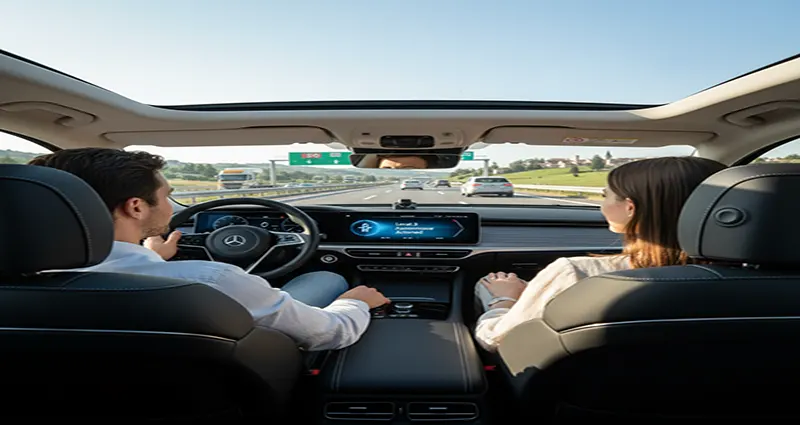
For the first time in automotive history, the “eyes-off, hands-off” dream has arrived on European motorways. As of early 2026, the regulatory landscape has shifted significantly. While Level 2 systems (like Tesla’s Autopilot or Volvo’s Pilot Assist) require you to keep your hands on the wheel and eyes on the road, Level 3 Conditional Automation allows the vehicle to take full legal and technical control under specific conditions.
In the European Union, this transition is governed by strict UN-R157 regulations and local traffic laws. Here is your comprehensive guide on how to safely and legally use Level 3 autonomous driving in 2026.
1. Understanding the Legal Framework: UN-R157
The backbone of Level 3 driving in the EU is the UN Regulation No. 157. Originally limited to low-speed traffic jams (up to 60 km/h), the regulation was updated to allow “Automated Lane Keeping Systems” (ALKS) to operate at speeds of up to 130 km/h (81 mph) on motorways.
The “Rules of Engagement”:
- Physical Separation: The system can only be activated on roads where traffic moving in opposite directions is physically separated (e.g., by a guardrail or concrete median).
- No Vulnerable Users: Pedestrians and cyclists must be prohibited from the road (motorway status).
- Driver Monitoring: The car must be equipped with an interior camera to ensure the driver is in the seat, buckled, and “available” to take back control.
2. How to Activate Level 3 (The Handover)
Unlike Level 2 systems that engage with a click of a button at any time, a Level 3 system like Mercedes-Benz DRIVE PILOT or BMW Personal Pilot will “offer” itself to you only when all safety criteria are met.
- Entry into the ODD: You must be within the “Operational Design Domain” (usually a mapped, high-speed motorway in clear weather).
- The Prompt: A specific light or icon (often turquoise or white) will appear on the steering wheel or dashboard, indicating the system is available.
- The Engagement: You press the “Autonomous” button. At this point, the steering wheel may retract slightly or the ambient lighting will change. The car now officially “owns” the driving task.
3. What You Can (and Can’t) Do While “Eyes-Off”
This is the biggest shift for EU drivers in 2026. When Level 3 is active, the driver is legally permitted to turn their attention away from the road to perform “secondary activities.”
- Permitted Activities: You can read a book, answer emails on the infotainment screen, watch a movie, or use the car’s built-in browser.
- Prohibited Activities: You cannot sleep, leave the driver’s seat, or become so distracted that you cannot hear the car’s alerts. You must remain “ready to intervene” within a 10-second window.
- Phone Usage: While you can use the car’s screen, many EU jurisdictions still prohibit holding a handheld mobile phone, even in Level 3 mode, to ensure you can grab the wheel instantly.
4. The Transition Demand: Taking Back Control
The most critical part of Level 3 is the Transition Demand. If the car encounters a situation it cannot handle—such as roadworks, a sudden storm, or the end of the mapped motorway—it will alert you.
The 10-Second Rule:
The system will provide a clear visual and audible warning. You have roughly 10 seconds to place your hands on the wheel and eyes on the road.
- If you take over: The system disengages, and you are back in manual control.
- If you fail to respond: The car will initiate a Minimal Risk Manoeuvre. It will turn on the hazard lights, slow down within its lane, and eventually come to a complete stop while initiating an eCall to emergency services.
5. Liability: Who is Responsible?
One of the most common questions in 2026 is: “If the car crashes while in Level 3, who pays?”
In the EU, the legal consensus is that the manufacturer is liable for the driving task while the Level 3 system is active and operating within its boundaries. However, if the car issues a “Transition Demand” and you fail to take over within the allotted time, the liability shifts back to the human driver. To manage this, all Level 3 cars are equipped with a “Black Box” (Data Storage System for Automated Driving) that records exactly who was in control during an incident.
Summary Table: Level 2 vs. Level 3 in the EU
| Feature | Level 2 (Partial) | Level 3 (Conditional) |
| Hands on wheel? | Required | Optional |
| Eyes on road? | Required | Optional (within ODD) |
| Legal Liability | Driver | Manufacturer (while active) |
| Max Speed (EU) | Up to speed limit | 130 km/h (subject to local law) |
| Secondary Activities | Prohibited | Permitted (e.g., Movies/Email) |
A New Relationship with the Road
Using Level 3 autonomy in the EU is about reclaiming your time during the most tedious parts of a journey. By 2026, countries like Germany, France, and the Czech Republic have led the way in integrating these systems into their national Highway Codes. As long as you respect the “10-second rule” and stay within the motorway network, the car is no longer just a tool—it’s your chauffeur.

