
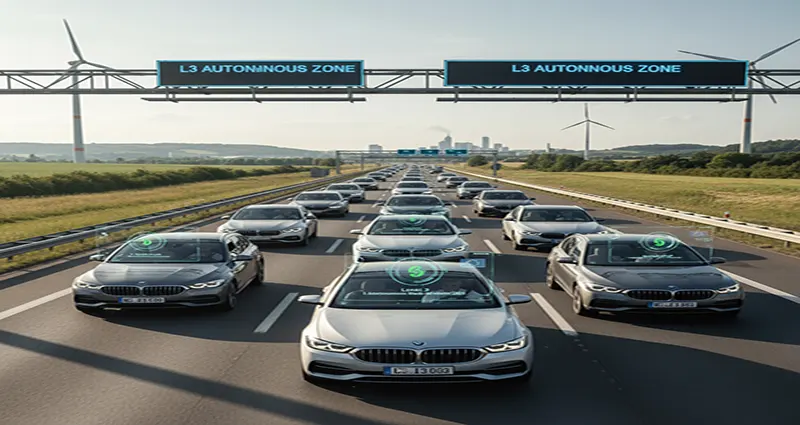
The year 2026 marks a watershed moment for European transportation. After years of small-scale pilots and cautious “hands-on” systems, the legislative floodgates have opened. As of January 1, 2026, new amendments to the UN Regulation No. 157 and harmonized EU road traffic laws have officially moved Level 3 autonomous driving from a novelty into a regulated reality on European highways.
For drivers, this means the car is no longer just assisting; it is, under specific conditions, the legal driver. Here is an in-depth look at the regulations governing Level 3 autonomy across the EU in 2026.
1. The 130 km/h Milestone: Speed and Scope
The most significant change in 2026 is the expansion of the Operational Design Domain (ODD). Previously, Level 3 systems were largely restricted to “Traffic Jam Pilots” operating at speeds below 60 km/h.
New Limits:
- Speed: The UN-R157 update now permits Automated Lane Keeping Systems (ALKS) to operate at speeds up to 130 km/h (81 mph).
- Lane Changes: For the first time, regulated systems are allowed to perform autonomous lane changes to overtake slower vehicles or follow navigation paths, provided the car is equipped with 360-degree sensor redundancy.
- Road Type: Usage remains restricted to “motorway-like” roads—those with a physical barrier separating oncoming traffic and no pedestrians or cyclists.
2. The “Hands-Off, Eyes-Off” Legal Standard
In 2026, the EU has clarified the “secondary activity” rules. When a Level 3 system is active, the human in the driver’s seat is no longer legally “driving” the vehicle.
What is Permitted:
- Digital Engagement: Drivers are legally allowed to use the vehicle’s integrated infotainment system to watch movies, answer emails, or browse the web.
- Physical Relaxation: Hands may be removed from the steering wheel, and the driver may turn their attention away from the road.
What is Prohibited:
- Sleeping: The driver must remain awake and upright.
- Leaving the Seat: The system will immediately disengage (and potentially emergency stop) if the seatbelt is unbuckled or the driver leaves the seat.
- Handheld Devices: Interestingly, many member states (including Germany and the Czech Republic) still restrict the use of handheld mobile phones to prevent “deep distraction” that might hinder a quick takeover.
3. The 10-Second Takeover Rule
The “Conditional” in Level 3 refers to the driver’s obligation to intervene when the system reaches its limit. The 2026 regulations have standardized the Transition Demand process.
If the car encounters heavy snow, complex roadworks, or an unmapped detour, it initiates a handover. The law stipulates a minimum 10-second window for the driver to resume control. During these 10 seconds, the car remains fully responsible for safety. If the driver does not respond, the car must execute a Minimal Risk Manoeuvre, which involves:
- Activating hazard lights.
- Slowing down and, if sensors permit, pulling onto the hard shoulder.
- Coming to a complete stop and triggering an emergency eCall.
4. Liability and the “Black Box” Requirement
One of the biggest hurdles to Level 3 was deciding who pays in an accident. The 2026 EU framework addresses this through the Data Storage System for Automated Driving (DSSAD).
- Manufacturer Liability: If the system is active and operating within its legal ODD, the manufacturer is generally held liable for collisions caused by system failure or software error.
- Driver Liability: Liability shifts to the driver the moment a “Transition Demand” is issued and the 10-second window expires, or if the driver overrides the system manually.
- The Black Box: Every Level 3 car must record a timestamped log of when the system was engaged, when a takeover was requested, and when the driver’s hands touched the wheel. This data is accessible to insurance companies and police to resolve disputes.
5. National Adoption: A Patchwork Joining Together
While the technical standards are set by the UN and EU, individual countries have had to update their national Highway Codes.
| Country | 2026 Level 3 Status | Unique Note |
| Germany | Fully Operational | Leads the EU with 13,000+ km of approved Autobahn. |
| Czech Republic | Operational | New 2026 laws permit L3 on all major motorways. |
| France | Operational | Focused on “L3 for Freight” to solve driver shortages. |
| Switzerland | Operational | Permits “Motorway Pilots” on all segregated highways. |
| UK | Pending/Partial | Following a separate “Automated Vehicles Bill” timeline. |
6. The Infrastructure Requirement: Digital Maps and V2X
The 2026 regulations also place a burden on the road itself. For a Level 3 system to be legally engaged, the vehicle must have access to a High-Definition (HD) Map with centimeter-level accuracy. Many EU motorways are now being equipped with V2X (Vehicle-to-Everything) beacons that broadcast real-time data about upcoming accidents or roadwork directly to the car’s computer, ensuring the L3 system has more “foresight” than a human driver.
Reclaiming the Commute
The 2026 regulations represent the end of the “assistance” era and the beginning of the “automation” era. By codifying exactly how, where, and at what speed a car can drive itself, the EU has provided the certainty manufacturers needed to roll out hands-free technology to the masses. For the first time, the “middle part” of a long European road trip is no longer a task to be performed, but time to be reclaimed.

