
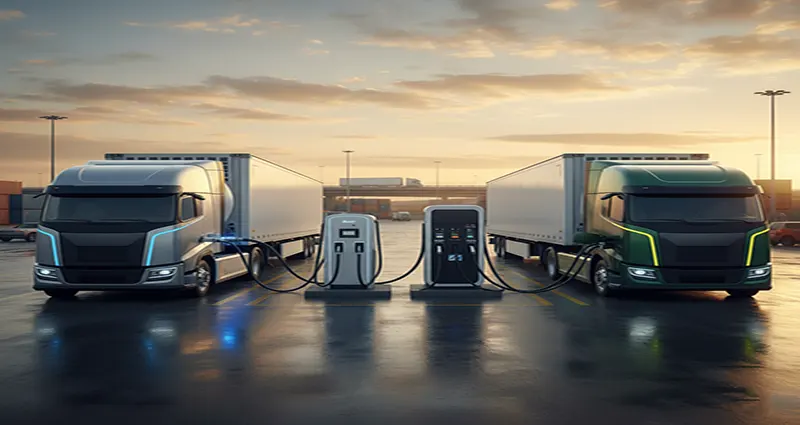
As the transportation sector races toward net-zero emissions, the “Heavy Duty” segment remains the most difficult to decarbonize. For decades, diesel was the undisputed king of the highway. However, in 2026, a fierce technological rivalry has emerged. On one side, we have Battery Electric Trucks (BETs), which dominate regional routes; on the other, Hydrogen Fuel Cell Electric Vehicles (FCEVs), which are being hailed as the savior of long-haul logistics.
For fleet managers and supply chain executives, the choice isn’t just about “going green”—it’s about payload, uptime, and the total cost of ownership (TCO).
The Core Technology: How They Differ
Both vehicles are technically electric. They use electric motors to turn the wheels. The difference lies in how they store and generate that electricity.
- Battery Electric (BET): Operates like a giant smartphone. It stores energy in massive lithium-ion or LFP (Lithium Iron Phosphate) battery packs. To “refuel,” you must plug it into the grid.
- Hydrogen Fuel Cell (FCEV): Operates like a miniature power plant. It carries tanks of compressed hydrogen gas. A fuel cell stack combines that hydrogen with oxygen from the air to create an electrochemical reaction, producing electricity and emitting only pure water vapor.
The Battle of the Specs: Long-Haul Performance
In long-haul logistics—defined as routes exceeding 400 miles (approx. 650 km)—three factors decide the winner: Range, Refueling Speed, and Payload.
1. Range and Reliability
FCEVs currently hold the upper hand for extreme distances. A hydrogen truck can typically cover 500 to 800 miles on a single fill. More importantly, hydrogen performance is less affected by cold weather. In contrast, heavy BETs often see a significant drop in range during winter months as energy is diverted to heat the battery and the cabin.
2. The Weight Penalty (Payload)
In the trucking world, weight is money.
- The BET Challenge: To achieve a 500-mile range, a Class-8 truck needs a battery pack weighing roughly 4,000 to 5,000 kg. This “dead weight” reduces the amount of actual cargo the truck can legally carry.
- The FCEV Advantage: A hydrogen system (tanks + fuel cell + a small buffer battery) is significantly lighter. Industry data suggests an FCEV loses only about 500–1,000 lbs of payload capacity compared to diesel, whereas a BET can lose up to 4,000 lbs.
3. Refueling vs. Charging
Time is the most expensive commodity in logistics.
- Hydrogen: Refills in 10–15 minutes, mirroring the diesel experience.
- Battery: Even with “Megawatt Charging Systems” (MCS) becoming available in 2026, a full charge for a long-haul battery can take 45 to 90 minutes. For multi-shift operations where the truck must stay moving 24/7, this downtime is a dealbreaker.
The Efficiency Paradox
While Hydrogen wins on “truck specs,” it loses significantly on energy efficiency. This is known as the “Well-to-Wheel” efficiency gap.
| Process Step | Battery Electric (BET) | Hydrogen Fuel Cell (FCEV) |
| Production/Transport | ~5% loss (Grid) | ~45% loss (Electrolysis + Compression) |
| On-board Conversion | ~10% loss (Battery/Motor) | ~50% loss (Fuel Cell/Motor) |
| Total Efficiency | 75% – 85% | 25% – 35% |
Because it takes nearly 3x more renewable electricity to move a hydrogen truck the same distance as a battery truck, the fuel cost for hydrogen remains stubbornly high.
Total Cost of Ownership (TCO) in 2026
As of 2026, the economic landscape is split:
- BETs have the lowest operating cost. If your route is predictable and you can charge overnight at a depot, the “fuel” (electricity) is cheap, and maintenance is minimal due to few moving parts.
- FCEVs have the highest potential for high-utilization. For “double-shifted” trucks that never stop, the ability to refuel quickly means the truck generates more revenue per day, which can offset the higher cost of hydrogen fuel.
Infrastructure: The Final Frontier
The “winner” of this debate may ultimately be decided by pipes and wires:
- Grid Strain: Charging a fleet of 50 BETs simultaneously requires a massive grid upgrade, often equivalent to powering a small town.
- Hydrogen Hubs: Hydrogen infrastructure is currently concentrated in “green corridors” (e.g., the Port of Rotterdam to Germany, or California’s coastal routes). Outside these hubs, finding a pump is nearly impossible.
A Segmented Future
The consensus for 2026 is that we are not headed toward a “winner-takes-all” scenario. Instead, the market is fragmenting based on use cases:
- Urban & Regional (Up to 250 miles): Battery Electric is the undisputed champion.
- Heavy Long-Haul (500+ miles / Heavy Loads): Hydrogen Fuel Cells are the only viable path to zero emissions without sacrificing significant payload.
For logistics providers, the “Golden Rule” is now: Electrify the short routes with batteries, and save the hydrogen for the long haul.

