
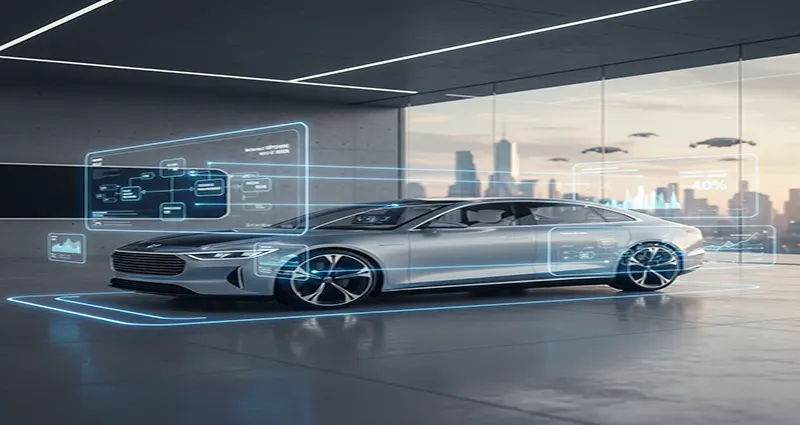
In 2026, the definition of a “luxury car” has moved beyond the quality of the leather stitching or the smoothness of the V12 engine. Today, luxury is defined by agility—the ability of a vehicle to learn, adapt, and improve long after it has left the showroom. This shift is powered by Software-Defined Vehicle (SDV) architecture, a fundamental re-engineering of the car’s “nervous system” that treats hardware as a vessel and software as the soul.
For the 2026 luxury buyer, the benefits of SDV architecture manifest in four key areas: evergreen functionality, hyper-personalization, advanced safety, and simplified physical complexity.
1. The “Evergreen” Vehicle: Ending Rolling Obsolescence
Traditionally, a car was at its peak performance the day you bought it; from that moment on, it began the slow slide into obsolescence. SDV architecture in 2026 luxury models like the BMW iX3 (Neue Klasse) or the Lucid Gravity turns this model on its head.
- Continuous Improvement: Through high-performance central computing and robust Over-the-Air (OTA) updates, 95% of a vehicle’s systems can now be upgraded remotely. Whether it’s a 10% boost in battery efficiency, a more natural AI voice assistant, or smoother suspension tuning, the car literally gets better with age.
- Feature-on-Demand: Luxury owners can now “download” performance. Need extra towing capacity for a weekend trip? Or a specialized “Track Mode” for a morning at the circuit? SDV allows these features to be unlocked via software, providing a level of flexibility previously impossible with hardware-locked ECUs.
2. Hyper-Personalization via AI Co-Pilots
The 2026 luxury cabin has evolved from a static interface into a “living room on wheels.” SDV architecture allows the vehicle to process vast amounts of data in real-time to curate the environment for the individual.
- Generative AI Integration: Leading 2026 models feature AI assistants powered by Large Language Models (LLMs), such as the BMW Intelligent Personal Assistant with Alexa+. These systems don’t just follow commands; they engage in natural dialogue, understanding complex requests like “Find me a scenic route to the hotel that includes a stop at a vegan café and has high-speed chargers along the way.”
- Predictive Comfort: By analyzing driver habits, the SDV architecture anticipates needs. It can adjust the seat bolsters, cabin lighting, and scent profile based on the driver’s stress levels or the time of day, creating a bespoke “wellness sanctuary” that learns from every mile.
3. Zonal Architecture: Weight Loss for Better Range
One of the most significant “invisible” benefits of SDV is the transition from distributed ECUs to Zonal Architecture. In older luxury cars, there were often over 80 discrete computers (ECUs) scattered throughout the frame, connected by miles of heavy copper wiring.
- Weight Reduction: By centralizing computing into “zones” (e.g., a single high-performance computer for the front-left section of the car), manufacturers have stripped away up to 50kg of wiring. For 2026 electric luxury SUVs, this weight savings directly translates into 5–10 extra miles of range.
- Reliability: Fewer physical connections mean fewer points of failure. If a sensor fails, the central SDV “brain” can often reroute data or use virtual sensors to maintain functionality until a repair is scheduled.
4. Safety 2.0: Predictive and “Human-Like” Autonomy
Safety in 2026 has moved beyond simple collision warnings. SDV architecture allows for Sensor Fusion, where data from LiDAR, Radar, and Cameras are processed by a single high-performance unit to create a 360-degree digital twin of the car’s surroundings.
- Behavioral Maneuvers: New for 2026, systems like those from HERE Technologies use millions of miles of fleet data to teach autonomous systems to drive more “humanly.” Instead of the robotic, jerky braking of early systems, 2026 luxury models steer and brake with a smooth, natural rhythm that builds passenger trust.
- Predictive Maintenance: The SDV doesn’t just wait for a warning light to turn on. It monitors micro-variations in motor heat, battery discharge, and tire vibration to predict a failure weeks before it happens. Owners receive a notification to schedule a mobile service tech before the vehicle even breaks down.
Comparison: Traditional vs. 2026 SDV Luxury Architecture
| Feature | Traditional Luxury (2020) | 2026 SDV Luxury Model |
| Computing | 80+ Separate ECUs | 2–3 High-Performance “Brains” |
| Updates | Dealer-visit only | Full 100% OTA Capability |
| Wiring | Heavy, complex looms | Simplified Zonal wiring |
| Lifecycle | Static (Depreciating Tech) | Evolving (App-like upgrades) |
| AI | Basic Voice Commands | Generative AI (LLMs) |
The Car as a Platform
In 2026, purchasing a luxury vehicle is no longer a final act; it is the beginning of a digital relationship. The Software-Defined Vehicle has turned the car into a platform—a high-performance, mobile computer that offers a safer, more personalized, and more efficient experience every time the driver steps inside.
As manufacturers like Hyundai (Pleos) and BMW (Neue Klasse) prove, the luxury of the future isn’t just about where the car can take you, but how the car grows with you.

