
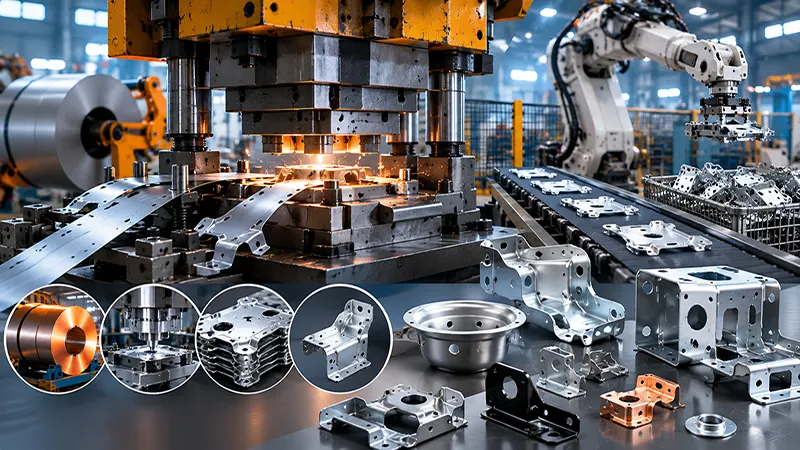
Pressed parts are everywhere in modern engineering, from automotive body structures and brackets to enclosures, appliance components, and electrical contacts. Made by forming sheet or coil metal under a press rather than cutting it from solid stock, pressed parts offer a combination of strength, repeatability, and low per-unit cost that few other processes match at volume. For engineers, designers, and procurement specialists, understanding how these components are produced, where they make sense, and what to specify is the key to getting reliable parts without unnecessary cost or delay.
This guide explains what pressed parts are, the main processes behind them, the material and design factors that determine success, and the practical guidance that helps technically minded readers make sound decisions. The approach is neutral and educational rather than a pitch for any single method or provider.
What Pressed Parts Are and How They Are Produced
A pressed part is formed by applying force through a die to deform flat metal into a finished three-dimensional shape. Because the process reshapes material rather than removing it, it is fast and highly material-efficient, which is why pressing dominates high-volume metal component production. The same setup often combines cutting and forming operations, so that a strip of coil enters the press and a finished part exits.
The economics rest on tooling. A die is a part-specific investment that can be costly to build, but once that cost is spread across a large production run, the per-part cost becomes very low. This is the central trade-off of pressed parts: high upfront tooling cost in exchange for low unit cost at scale, which makes the process ideal for volume production and less suited to one-off or very low-volume work.
The Main Processes Behind Pressed Parts
Several distinct operations fall under pressing, and complex components often combine more than one. Choosing among them depends on geometry, volume, and the function the part must perform.
Blanking and Piercing
Blanking cuts the flat shape from the sheet or coil, while piercing creates holes and openings. These cutting operations frequently form the first stations in a larger pressing sequence, defining the outline and features before any forming takes place.
Bending and Forming
Bending deforms the blank along straight axes to create flanges, channels, and profiles, while more general forming produces curves and contours. The key design variables are bend radius, material thickness, and grain direction, all of which influence whether a feature forms cleanly or cracks.
Deep Drawing
Deep drawing pulls the blank into a die cavity to create hollow shapes such as cups, housings, and tank sections, where depth is significant relative to width. It demands careful control of blank-holder force and lubrication so the material flows without tearing or wrinkling, and it generally suits higher volumes that justify the more complex tooling.
Progressive Pressing
For high-volume parts, progressive dies move a coil strip through a series of stations, each performing one operation, so a finished part emerges at the end of the line. This is the most economical route at scale, combining many operations into a single tool, but it carries the highest upfront tooling cost and the least flexibility once built.
Press Technology Shapes What Is Achievable
The press driving the operation is as important as the die itself, and different press types suit different jobs:
- Mechanical presses: fast and highly repeatable, well suited to simpler, high-volume parts where the stroke profile does not need to vary.
- Hydraulic presses: deliver full force throughout the stroke with adjustable force, making them better for deep draws and thicker material.
- Servo presses: allow the stroke speed and force profile to be programmed within a single cycle, which helps with difficult-to-form alloys and parts prone to springback, since the ram can slow precisely where the material needs it.
Matching the press to the part is part of producing a sound pressed component. A deep draw attempted without adequate full-stroke force, for example, can lead to inconsistent parts or tearing. Readers looking at how cutting, forming, and joining combine in the production of pressed parts can consult a practical reference on how these stages integrate within a single production environment.
Material Selection Determines Manufacturability
Material choice has a direct effect on how a part forms and how the tooling behaves over time. Several properties matter in particular:
- Formability: how much a material can deform before it cracks, often described through elongation and the forming limit diagram.
- Work hardening: the tendency of materials such as stainless steel to harden as they deform, raising the required force and accelerating tool wear.
- Springback: the elastic recovery after forming, more pronounced in high-strength materials and compensated for in the die design.
- Corrosion resistance: whether the part needs coated, stainless, or treated material for its operating environment.
The trend toward lightweighting, using thinner gauges and advanced high-strength steels or aluminum, has made material behavior harder to manage. The forgiving formability of mild steel does not carry over to high-strength grades, which is why forming simulation has become a standard design tool. Modeling how a part will form before tooling is cut lets engineers predict thinning, cracking, and springback, and adjust the die in advance rather than through expensive physical trials.
Designing Pressed Parts Well
Most cost and quality problems in pressed parts originate in the design phase, where they are cheapest to fix. A few principles consistently prevent trouble:
- Specify bend radii appropriate to the material and gauge rather than tighter than necessary, to avoid cracking at bend lines.
- Keep holes and features a sensible distance from bends, where forming would otherwise distort them.
- Account for springback in the design rather than correcting it through repeated die rework.
- Call out tolerances that match the function, since unnecessarily tight tolerances force costly secondary operations.
- Choose material with the intended forming in mind, checking formability before committing to a grade for cost or weight reasons.
- Involve forming engineers early, while changes can still be made on the screen rather than in hardened tool steel.
The unifying theme is that design and tooling decisions are inexpensive to change early and expensive to change once a die is cut. Early collaboration between designers and pressing specialists reliably prevents the most costly issues.
Where Pressed Parts Are the Right Choice
Pressing is not the answer to every component, and recognizing when it fits is part of sound engineering. Pressed parts excel where production volumes are high enough to amortize tooling, where the geometry suits sheet-formed shapes, and where consistency across large runs is essential. Their strengths include low per-part cost at volume, excellent repeatability, good strength-to-weight characteristics, and the ability to integrate several features into one formed part.
They are less suitable for very low volumes, where tooling cost cannot be recovered, and for complex solid geometries better suited to machining or casting. For low-volume or prototype needs, flexible methods such as laser cutting and machining often make more sense, sometimes as a bridge before committing to pressing tooling once volumes are confirmed.
Cost, Quality, and Lead Time Factors
Three factors dominate the practical economics of pressed parts. Cost is split between the upfront, one-time tooling investment and the per-part cost driven by cycle time, material, and secondary operations, with high volumes rewarding dedicated tooling. Quality depends on process control during production, since pressing is highly repeatable but only as good as the consistency maintained across a run. Lead time is dominated by tooling: designing, building, and validating a die for a complex part can take months, and that timeline must be planned backward from the production launch date. Underestimating tooling lead time is one of the most common causes of schedule pressure in component programs.
The Fundamentals That Determine Success
Pressed parts deliver a powerful combination of low unit cost, repeatability, and strength, which is why they are so widespread in volume manufacturing. The right process, whether blanking, bending, deep drawing, or progressive pressing, depends on the part’s geometry, volume, and material, and each carries its own trade-offs in tooling, flexibility, and cost. Material behavior and thoughtful design, especially around bend radii and springback, determine whether a part succeeds, which is why simulation and early engineering involvement have become so valuable. Readers who understand these fundamentals are best placed to specify pressed parts that meet their requirements without the costly rework and delays that catch less-prepared programs.
Frequently Asked Questions
When do pressed parts become more economical than machined parts?
Pressing becomes more economical as volume rises, because the upfront tooling cost spreads across more parts and the per-part cost is low. At low volumes, machining or laser cutting often wins since they avoid large tooling investments. The crossover depends on part complexity and the specific tooling cost involved.
What causes cracking in pressed parts and how is it avoided?
Cracking usually stems from bend radii too tight for the material and gauge, forming across an unfavorable grain direction, or pushing a material beyond its formability limit. It is avoided by specifying appropriate bend radii, selecting a material with adequate formability, and using forming simulation to predict problem areas before tooling is cut.
Can pressed parts hold tight tolerances?
Pressing is highly repeatable, so it holds consistent tolerances well across a run, but extremely tight tolerances may require secondary operations or careful die design and add cost. Specifying tolerances that match the part’s actual function, rather than tighter than needed, keeps cost under control.
Why does tooling lead time matter so much for pressed parts?
Because a press die is a complex, part-specific tool that takes time to design, build, and validate, often months for a complex part. This lead time dominates the start of a program and must be planned backward from the launch date. Treating it as a late-stage task frequently causes schedule pressure and compromises on validation.

