
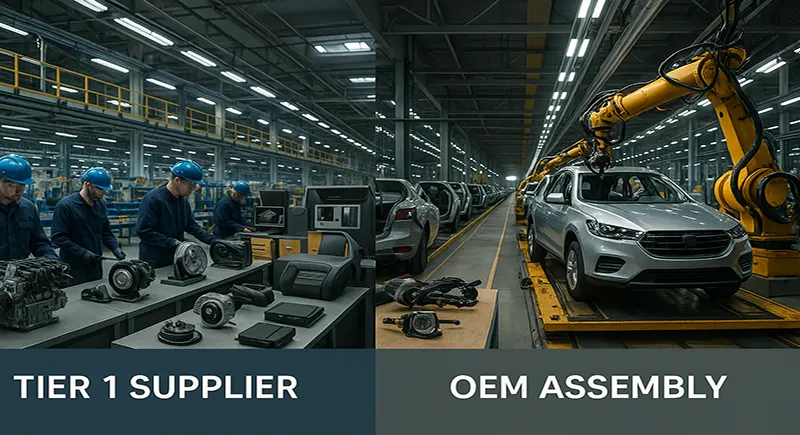
The automotive world is an ecosystem of massive collaboration, and understanding its core players is essential for anyone entering the industry. At the top of the food chain are two critical entities: the OEM and the Tier 1 supplier. This relationship is the backbone of vehicle production, dictating everything from design to delivery.
To simplify this complex dynamic, think of it this way: The car manufacturer is the restaurant chef (the OEM), and the major component provider is the specialized catering company (the Tier 1). The chef designs the menu and plates the final meal; the caterer delivers perfect, pre-cooked courses ready for assembly. Our goal here is to explain simply who does what in the final vehicle assembly.
Defining the OEM (Original Equipment Manufacturer)
The OEM (Original Equipment Manufacturer) is the company whose name and badge appear on the car you buy—the brand (e.g., Ford, Toyota, BMW). They are the “Boss” or the “End-Brand.”
The OEM’s primary focus is on the entire vehicle concept and the customer experience. They don’t have the time or specialized expertise to manufacture every single part, but their responsibilities are crucial:
| o | Overall Vehicle Architecture: Designing the structure, styling, and general performance specifications of the car. |
| o | Brand Quality Control: Setting the rigorous quality and safety standards that every single component, whether made internally or supplied, must meet. |
| o | Final Assembly: Bringing all the various systems and modules together on the assembly line to build the final, integrated product. |
| o | Marketing and Sales: Managing the brand image, setting the final price, and running the global dealership network. |
Crucially, the OEM’s central job is integration. They must ensure that the braking system (from Company A), the infotainment system (from Company B), and the engine (from Company C) all fit together seamlessly, operate without conflict, and meet the company’s demanding performance targets.
Defining the Tier 1 Supplier
The Tier 1 Supplier is a company (like Bosch, Magna, or Continental) that supplies complex systems or components directly to the OEM. They are the “Specialist” or the “System Provider” who possess deep expertise in a specific technical area.
The Tier 1 company operates one step below the OEM in the supply chain pyramid and often delivers the most valuable parts:
| o | Role: To design, test, and deliver fully functional, ready-to-install modules or systems. They don’t supply raw materials; they supply complete assemblies, such as a full transmission, a complete dashboard and airbag system, or an entire seating arrangement. |
| o | Key Responsibilities: They carry significant R&D (Research and Development) responsibility for their specialized system. They must ensure high-volume manufacturing capability and, critically, adhere to JIT (Just-in-Time) delivery schedules, meaning parts arrive at the OEM’s assembly line precisely when they are needed—not too early, and never too late. |
| o | Key Distinction: The term “Tier 1” is defined by this direct relationship. A Tier 1 company often manages its own supply chain of Tier 2 and Tier 3 companies beneath them (who supply components and raw materials), packaging all that work into one finished module for the OEM. |
The Critical Relationship: Dependence and Collaboration
The relationship between an OEM and a Tier 1 supplier is deeply symbiotic. The OEM simply cannot build a modern, complex vehicle without the Tier 1’s decades of specialization in brakes, electronics, or seating. Conversely, the Tier 1 depends on the OEM for massive, stable volume contracts to fuel their high-capacity global factories.
This relationship is best understood through a real-world example, such as a car’s seat:
| o | The Tier 1 Supplier (e.g., Adient or Lear) handles the engineering: designing the metal frame, developing the internal motors for power adjustment, designing the foam density for comfort, conducting safety crash tests, and ensuring the final, complete seat assembly can be plugged right into the car’s floor and electrical system on the OEM’s assembly line. |
| o | The OEM specifies the overall dimensions, the electronic controls needed for adjustment, and the final look (e.g., leather or cloth upholstery). They are the final customer. |
In essence, the OEM pays for the final, integrated system, but the Tier 1 is the master engineer behind the specific technology.
The core difference is one of focus: the OEM concentrates on the whole car, the brand, and the customer experience, focusing on integration. The Tier 1 supplier focuses on mastering complex, dedicated modules and delivering them perfectly on time.
Looking ahead, this distinction is becoming slightly blurred. The rise of the software-defined vehicle means that OEMs are bringing more software development and data expertise in-house. While they will still rely on Tier 1s for hardware, the battleground is shifting. Understanding this tiered system, however, remains fundamental to grasping how the global automotive industry operates and how innovation truly reaches the road.

