
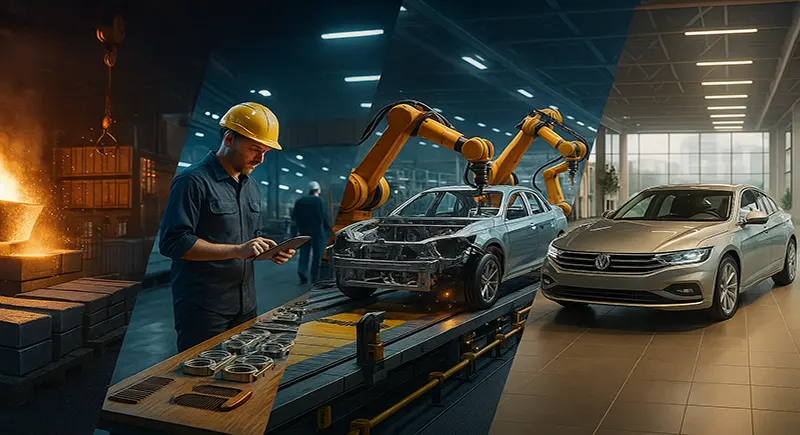
The automotive industry relies on one of the most complex logistical networks in the world. A single modern vehicle is composed of tens of thousands of individual components, all of which must arrive at the assembly line in perfect sequence and timing. This intricate journey, known as the automotive supply chain, starts deep in the earth and finishes on the dealership floor. Tracing this process reveals a highly coordinated system, built on layers of dependency, that transforms basic resources into sophisticated machines.
Tier Zero: The Foundation of Raw Materials
The foundation of every car begins with raw materials sourced from around the globe. This Tier Zero level includes vast quantities of steel and aluminum for the body and chassis, plastics and rubber for the interior and tires, and critical minerals like lithium, cobalt, and rare-earth magnets essential for electric vehicle (EV) batteries and electronic components.
These materials require significant mining, extraction, and initial processing before they can enter the manufacturing system. A key constraint and growing focus for the industry is sustainability and ethical sourcing. Given the social and environmental risks associated with the extraction of materials like cobalt, automakers are under increasing pressure to implement rigorous due diligence to ensure supply chains are transparent and free from negative ecological or human rights impacts, thereby driving the demand for responsible procurement practices.
Tier 1, 2, and 3: The Manufacturing Hierarchy
The automotive supply chain is organized in a hierarchical pyramid, moving from simple components at the base to complex modules at the top.
| o | Tier 3 Suppliers: These companies form the broad base, providing the smallest, most fundamental inputs, such as raw plastics, small fasteners, basic metal stampings, and electronic components like resistors and capacitors. They supply the tiers above them. |
| o | Tier 2 Suppliers: These companies take the materials and parts from Tier 3 and assemble them into sub-systems. Examples include wiring harnesses, pre-fabricated seat frames, or semi-processed castings. They primarily supply Tier 1 companies. |
| o | Tier 1 Suppliers (Crucial Focus): These are the primary partners that interact directly with the automaker. A Tier 1 supplier doesn’t deliver individual screws; they deliver complete, ready-to-install modules or systems—like a full engine assembly, a pre-tested dashboard and infotainment system, or a complete brake module. They often hold the design and engineering responsibility for these entire systems. |
This tiered system is governed by the Just-in-Time (JIT) logistics model. JIT is an inventory management strategy in which materials and components are delivered to the assembly line just as they are needed for production, rather than being stored in large, costly warehouses. This minimizes inventory holding costs and waste but places extreme pressure on every supplier in the chain to maintain perfect timing and quality.
The OEM Assembly Line
The OEM (Original Equipment Manufacturer), the brand that designs, assembles, and sells the final vehicle (e.g., Ford, Toyota, BMW), sits at the top of the pyramid. The OEM assembly line is where the culmination of the entire supply chain happens. Here, the complex, pre-assembled modules from the Tier 1 suppliers are merged with the car body and chassis in a highly coordinated ballet of manufacturing.
The precision required to synchronize hundreds of Tier 1 deliveries with the production pace is immense. However, this lean JIT system is incredibly vulnerable to global disruptions. The recent semiconductor shortage provided a stark lesson: modern vehicles rely on hundreds of microchips for everything from engine management to advanced driver-assistance systems. When the global chip supply was throttled by the pandemic and unexpected surges in consumer electronics demand, automakers, lacking substantial buffer stock, were forced to halt or slow production, resulting in millions of lost vehicles and billions in lost revenue. This single component disruption exposed the fragility of the entire, highly optimized chain.
Logistics and The Final Mile: Delivery to the Dealership
Once a vehicle rolls off the assembly line, it becomes part of the outbound logistics stream. Finished vehicles are loaded onto specialized railcars, transport trucks, or maritime vessels to be distributed globally. This stage requires efficient route planning to minimize damage and delivery time.
The process culminates at the dealership, which acts as the final link between the manufacturer and the customer. The dealership manages the sale, financing, and delivery, and perhaps most crucially, handles post-sale service and repair, which creates a continuous demand signal that feeds back into the supply chain for spare parts.
Basically, the automotive supply chain is an extraordinarily complex, deeply interdependent machine. Its efficiency, driven by principles like Just-in-Time, is its greatest strength, but also its critical vulnerability. As the industry shifts rapidly toward electric vehicles (EVs) and autonomous technologies, the supply chain must evolve further. This transition is not just about changing parts, but about entirely new inputs (like battery minerals) and logistics models, demanding unprecedented agility and resilience from every tier.

