
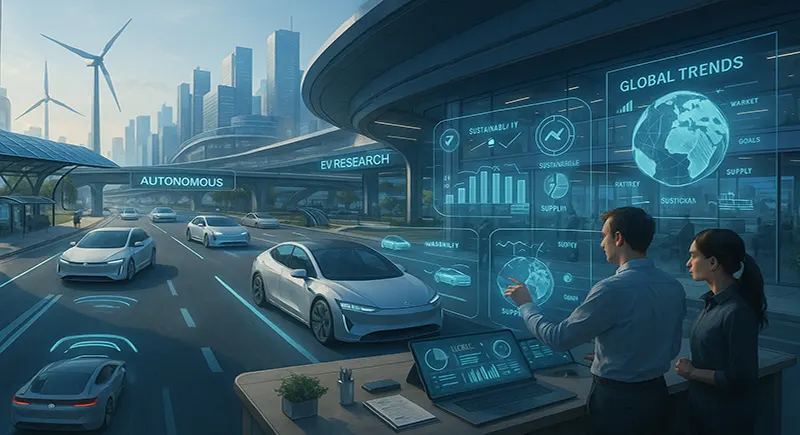
The automotive industry is currently undergoing its most profound transformation in a century. Driven by technological innovation, shifting consumer values, and urgent environmental mandates, the traditional model of building and selling cars is fundamentally changing. This article aims to outline the major transformative trends and the critical challenges that will define the competitive landscape of the global car industry by the year 2030. The ability of manufacturers to successfully navigate these shifts will determine their survival and success in the coming decade.
Trend 1: Electrification Dominance
By 2030, the shift to Electric Vehicles (EVs) will move from a niche movement to an industry-defining reality, making electrification the primary powertrain for new vehicles in many key markets. This acceleration is fueled by major battery technology advancements that increase energy density and reduce costs, coupled with aggressive government regulations and generous incentives designed to curb internal combustion engine (ICE) sales. While consumer adoption rates are rising steadily alongside the build-out of crucial charging infrastructure, the industry faces a significant bottleneck.
The primary challenge lies in securing the necessary raw materials. The reliance on minerals like lithium, cobalt, and nickel creates supply chain constraints and geopolitical vulnerabilities. Furthermore, manufacturers must address the urgent need for sustainable battery lifecycle management. Developing robust recycling processes and closed-loop systems is paramount to achieving true long-term environmental sustainability and reducing dependence on environmentally taxing mining operations.
Trend 2: Autonomy and Connectivity
The car of 2030 will be defined not by its engine, but by its code. This is the era of the software-defined vehicle. Progress toward autonomous driving will see many mainstream models offering Level 3 (L3) hands-off capabilities, with commercial fleets and specialized sectors pushing into Level 4 (L4) autonomy in controlled environments.
Driving this change is the rapid integration of connectivity features. Technologies like V2X (Vehicle-to-Everything) communication will allow cars to communicate with infrastructure and other vehicles, drastically improving safety and traffic flow. This connectivity also enables OTA (Over-The-Air) updates, allowing manufacturers to improve features and fix bugs post-sale. The resulting data streams present a massive opportunity for data monetization, transforming automakers into technology service providers.
However, these advancements introduce profound non-technological challenges. Complex and varied regulatory hurdles across different jurisdictions threaten to slow deployment. Meanwhile, the reliance on constant connectivity escalates cybersecurity risks, making vehicles a target for malicious attacks. Ultimately, gaining broad public acceptance and trust in autonomous decision-making remains a critical, final hurdle.
Trend 3: New Mobility Models & Digitalization
The concept of car ownership itself is evolving. By 2030, new mobility models will have matured significantly, challenging the traditional one-car-per-family model. Services such as sophisticated car-sharing, flexible long-term subscriptions, and refined ride-hailing will increasingly provide transportation as a service, especially in dense urban areas.
Simultaneously, the entire customer relationship is undergoing digitalization. Automakers are moving away from the traditional dealer-centric model toward seamless online sales experiences and direct consumer engagement. AI-driven interactions will enable highly personalized services, maintenance, and marketing throughout the vehicle’s lifecycle.
The major challenge here is adapting traditional business models. Established Original Equipment Manufacturers (OEMs) must pivot from being purely hardware manufacturers to comprehensive service providers. This puts them in direct competition with agile tech giants and specialized mobility startups that possess native software and data expertise.
Overarching Industry Challenges by 2030
Beyond the technological shifts, the industry faces fundamental non-technological pressures:
| o | The Talent Gap: The sudden transformation into a software-centric industry has created a massive demand for highly specialized software engineers, data scientists, and AI experts. Traditional automotive companies must compete aggressively with Silicon Valley for this talent, all while managing the transition of their existing, massive workforce accustomed to mechanical engineering. |
| o | Geopolitical Shifts: Increased global instability is leading to regionalization of supply chains. Protectionist policies and the threat of trade wars are forcing companies to duplicate manufacturing and sourcing capacity closer to their end markets, eroding the cost efficiencies of globalization. |
| o | Sustainability Pressure (Beyond EVs): Environmental, Social, and Governance (ESG) demands extend far beyond the tailpipe. Pressure to adhere to circular economy principles for all materials, reduce lifecycle emissions in manufacturing, and ensure ethical labor practices will be non-negotiable compliance standards for market access. |
The global car industry of 2030 will be virtually unrecognizable from its past. The immense pressure on OEMs to innovate and adapt simultaneously across electrification, autonomy, and digital customer engagement is unprecedented. Success will hinge on their ability to master the software-defined vehicle, secure sustainable supply chains, and embrace new, service-oriented business models. Only the most agile and strategically forward-thinking organizations will thrive in this new era of mobility.

