

German Automotive Industry Strategy Against Chinese EV Market Competition
The decades-long dominance of German engineering, synonymous with automotive quality and innovation, is facing an unprecedented strategic challenge. Aggressive, high-tech, and low-cost Chinese EV entrants, such as BYD and Nio, are rapidly gaining market share not only in their home territory but also increasingly in Europe. The core of this threat lies in their command of electric vehicle technology and their efficient manufacturing pipelines. This article will dissect the core strategies German Original Equipment Manufacturers (OEMs)—including BMW, Mercedes-Benz, and the Volkswagen Group—are deploying to defend their market share and regain a decisive competitive edge in the electric era.
The Threat Assessment: Speed and Cost
The nature of the Chinese competitive advantage is two-fold: speed of development cycles and cost efficiency. Chinese EV players have mastered vertical integration, controlling everything from battery cell production and software development to final assembly. This control allows them to iterate rapidly and … Continue reading >>>


The High Cost of Red Tape: Impact of Brexit on UK Car Manufacturing and Rules of Origin Tariffs
The UK automotive sector, a cornerstone of the national economy, relies heavily on frictionless trade with the European Union, which remains its single largest export market. The end of the Brexit transition period in 2021 introduced the UK-EU Trade and Cooperation Agreement (TCA), a deal that, while avoiding an immediate collapse into World Trade Organization (WTO) tariffs, created substantial trade friction. This article details how the TCA, particularly its complex Rules of Origin (ROO) provisions, has raised costs, increased administrative burdens, and now poses an existential threat to the long-term viability of UK car production.
The Pre-Brexit Model: Just-in-Time & Deep Integration
Prior to 2021, the UK’s relationship with the EU Single Market was characterized by deep component integration. Automotive supply chains spanned the continent, with parts—often sourced multiple times—crossing borders tariff-free and without complex customs checks. This system allowed UK manufacturing plants to operate a highly efficient Just-in-Time … Continue reading >>>
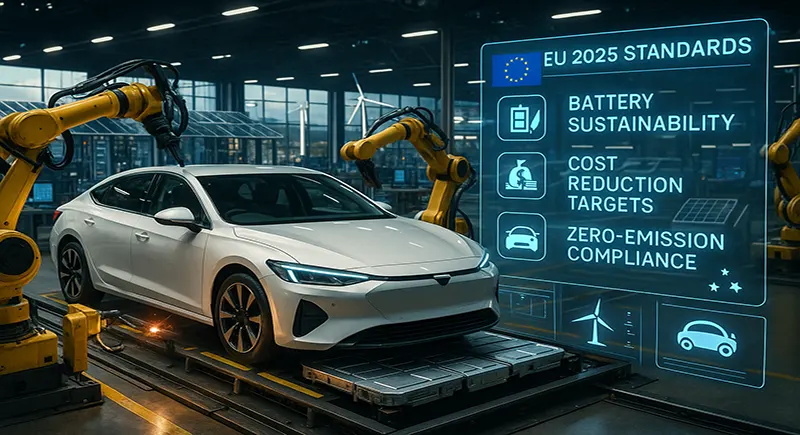
Latest EU Regulations on Affordable Electric Vehicle Production by 2025
The European Union’s ambitious climate goals—to achieve carbon neutrality by 2050—rest heavily on the mass adoption of electric vehicles (EVs). However, widespread uptake is currently hampered by the barrier of high initial purchase costs for many consumers. In response, the EU has employed a two-pronged strategy: punitive emissions targets to force manufacturers to produce more EVs, and systemic regulations to drive down long-term production costs. This article details the critical EU legislative actions aimed at boosting affordability by 2025 and examines the policy challenges in meeting these goals.
The Legislative Context: CO2 Targets and the ICE Phase-Out
The overarching legislative framework is the commitment to phase out new sales of internal combustion engine (ICE) vehicles by 2035. This hard deadline creates existential pressure on automakers. More immediately, the EU imposes stringent CO2 emission reduction targets for automakers’ average fleet sales.
The next major reduction stage is 2025, which … Continue reading >>>
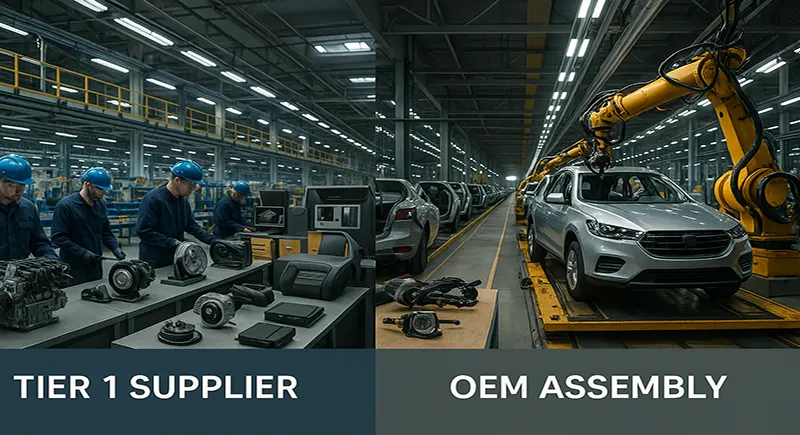
Who Builds Your Car? OEM vs. Tier 1 Supplier Explained Simply for Business Beginners
The automotive world is an ecosystem of massive collaboration, and understanding its core players is essential for anyone entering the industry. At the top of the food chain are two critical entities: the OEM and the Tier 1 supplier. This relationship is the backbone of vehicle production, dictating everything from design to delivery.
To simplify this complex dynamic, think of it this way: The car manufacturer is the restaurant chef (the OEM), and the major component provider is the specialized catering company (the Tier 1). The chef designs the menu and plates the final meal; the caterer delivers perfect, pre-cooked courses ready for assembly. Our goal here is to explain simply who does what in the final vehicle assembly.
Defining the OEM (Original Equipment Manufacturer)
The OEM (Original Equipment Manufacturer) is the company whose name and badge appear on the car you buy—the brand (e.g., Ford, Toyota, … Continue reading >>>
The Road Ahead: Future Trends and Challenges for the Global Car Industry in 2030
The automotive industry is currently undergoing its most profound transformation in a century. Driven by technological innovation, shifting consumer values, and urgent environmental mandates, the traditional model of building and selling cars is fundamentally changing. This article aims to outline the major transformative trends and the critical challenges that will define the competitive landscape of the global car industry by the year 2030. The ability of manufacturers to successfully navigate these shifts will determine their survival and success in the coming decade.
Trend 1: Electrification Dominance
By 2030, the shift to Electric Vehicles (EVs) will move from a niche movement to an industry-defining reality, making electrification the primary powertrain for new vehicles in many key markets. This acceleration is fueled by major battery technology advancements that increase energy density and reduce costs, coupled with aggressive government regulations and generous incentives designed to curb internal combustion engine (ICE) sales. … Continue reading >>>